Municipal water suppliers in the United States are required by law to deliver water that meets federal safety benchmarks, but compliance with legal minimums does not guarantee optimal taste, odor, or clarity at your kitchen faucet. Distribution infrastructure can introduce rust, copper, and sediment after the water leaves the central treatment plant. Older home plumbing may still contain lead solder or brass fixtures that leach metals into standing water, while residual disinfectants can produce unpleasant chemical odors. Installing a countertop water filter provides a practical way to manage these localized issues without the expense or permanent plumbing modifications required by under-sink reverse osmosis units.
Selecting the right countertop system demands more than choosing a popular brand or relying on generic marketing claims. Countertop devices fall into distinct operational categories, from passive gravity-fed stainless steel vessels to continuous-flow diverter units plumbed directly to your faucet aerator. Each design relies on specific physical media, such as extruded solid carbon blocks, hollow ceramic candles, or loose granular beds. To protect your household budget and target the actual contaminants in your pipes, you must match the engineering of the filter to the precise chemistry of your municipal supply.
Interpreting Your Annual Municipal Water Report
Every community water supplier must publish an annual Consumer Confidence Report (CCR) by July 1. This document itemizes the regulated contaminants detected in the water supply during the previous calendar year, alongside their legal limits and public health targets. You can typically download this report directly from your local water authority website or request a printed copy through municipal billing services. If your water comes from a private well, municipal reports do not apply, and you should commission an independent laboratory test certified by the state environmental protection agency.
When reviewing the data tables in a CCR, focus on three primary acronyms. The Maximum Contaminant Level (MCL) represents the highest level of a contaminant that regulations allow in drinking water. The Maximum Contaminant Level Goal (MCLG) is the level below which there is no known or expected health risk, often set to zero for toxic heavy metals such as lead. Finally, the Action Level (AL) is a concentration threshold that, if exceeded in more than 10 percent of sampled taps, forces the municipality to install additional corrosion control or treatment protocols. In the case of lead, the federal Action Level is 15 parts per billion (ppb), but public health authorities emphasize that no safe exposure level exists for infants and young children.
Disinfectants and their chemical byproducts represent the most common reason homeowners seek countertop filtration. Water utilities generally treat supplies with free chlorine or chloramines (chlorine combined with ammonia) to kill bacterial pathogens. While chlorine dissipates rapidly, chloramines remain in distribution pipes longer and create a persistent, medicinal taste. Chloramines also react with natural organic matter to form total trihalomethanes (TTHMs) and haloacetic acids (HAA5), both of which appear in the CCR in parts per billion or milligrams per liter (mg/L). Standard carbon filters reduce basic chlorine quickly, but removing chloramines and disinfection byproducts requires catalytic-grade carbon with prolonged contact time.
| Contaminant Category | Common Examples | Typical Reporting Units | Primary Treatment Target |
|---|---|---|---|
| Primary Disinfectants | Free Chlorine, Chloramines | Parts per million (ppm) or mg/L | Taste, odor, skin irritation |
| Disinfection Byproducts | Chloroform, Bromoform (TTHMs), HAA5 | Parts per billion (ppb) or ug/L | Potential long-term health risks |
| Inorganic Metals | Lead, Copper, Nitrate | Parts per billion (ppb) or mg/L | Neurological and cellular toxicity |
| Secondary Parameters | Iron, Total Dissolved Solids, Hardness | Grains per gallon (gpg) or ppm | Scale buildup, staining, cloudiness |
Comparing Gravity Pitchers and Pressurized Counter Units
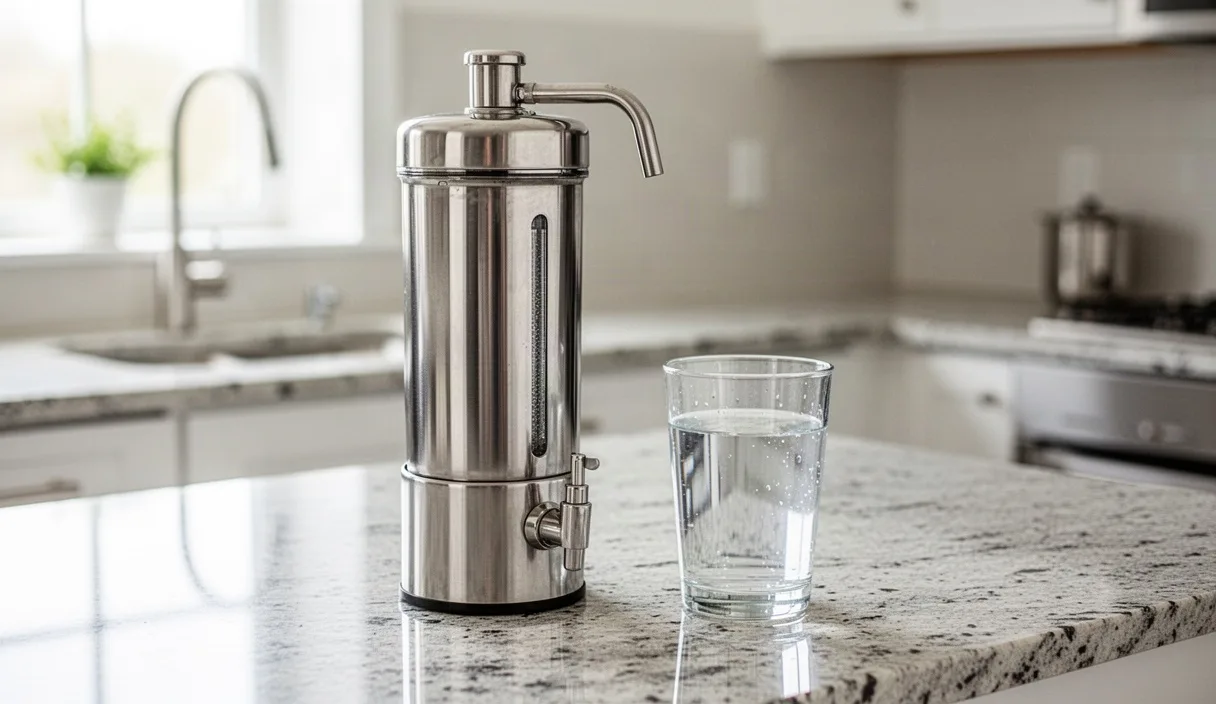
Countertop systems operate through one of two physical mechanisms: atmospheric gravity flow or pressurized line diversion. Gravity pitchers and dual-chamber stainless steel urns rely strictly on the weight of the water column to push fluid downward through a porous cartridge into a lower storage basin. Faucet-diverter systems use water pressure from the municipal line, which typically ranges between 35 and 65 pounds per square inch (psi), to force water horizontally or vertically through a sealed housing before exiting a dedicated swivel spout.
Gravity-fed units require no plumbing connections, adapter rings, or electrical outlets. They sit freely on countertops, kitchen islands, or refrigerator shelves. Because they operate under low pressure, they offer long contact time between the water and the internal media. This sustained exposure can help dense carbon or ceramic formulations trap volatile organic compounds and heavy metals. However, gravity units are inherently slow. A double-element stainless steel gravity system produces between 1.5 and 3.5 liters of filtered water per hour, depending on the height of the water level in the upper chamber. They also consume significant counter depth and vertical space, with large canisters standing between 18 and 26 inches tall.
Pressurized countertop filters connect directly to the kitchen faucet using a diverter valve that replaces the standard aerator. Pulling a small pin on the diverter channels tap water through a flexible tube into the filter housing and out through an integrated spout at rates between 0.5 and 0.8 gallons per minute. This on-demand volume makes them superior for filling pasta pots, rinsing vegetables, and washing delicate produce. The primary limitation involves faucet compatibility: modern pull-down spray faucets, square designer spouts, and fixtures with internal metric threading often cannot accept standard diverter collars without custom brass adapters that risk stripping delicate threads.
| Feature | Gravity Urn / Pitcher | Pressurized Faucet-Diverter |
|---|---|---|
| Driving Force | Atmospheric pressure, gravity | Household line pressure (35-65 psi) |
| Flow Rate | 1.5 to 3.5 liters per hour | 0.5 to 0.8 gallons per minute |
| Installation | Zero installation, manual fill | Aerator replacement, diverter hose |
| Faucet Compatibility | Universal (no connection needed) | Standard male/female aerators only |
| Bacterial Risk | Higher (open reservoir, ambient air) | Lower (closed sealed system) |
Evaluating Solid Carbon Blocks Versus Ceramic Elements
The interior material of a countertop cartridge determines which chemical and particulate compounds it can physically intercept or chemically adsorb. The two most durable media in modern countertop filtration are extruded solid carbon blocks and microporous ceramic candles. Understanding the mechanical differences between these elements prevents purchasing an inadequate system for your water profile.
Solid carbon blocks are manufactured by binding fine powdered activated carbon particles together under intense heat and pressure. This creates a dense, uniform structure with an absolute pore rating often between 0.5 and 5 microns. Unlike loose granular activated carbon (GAC), which can develop internal channels that let water bypass filtration, carbon blocks force every drop through tortuous pathways. The carbon matrix chemically adsorbs chlorine, pesticides, benzene, and bad tastes, while specialty resin additions can bind soluble lead and mercury via ion exchange. If your CCR shows high chloramines, standard carbon will exhaust itself prematurely; look specifically for catalytic carbon blocks, which contain altered surface structures engineered to break the strong chemical bonds of chloramine molecules.
Ceramic elements are hollow cylinders formed from kiln-fired diatomaceous earth. They feature an exceptionally fine pore size, typically ranging from 0.5 down to 0.2 microns. This microscopic matrix acts as a physical sieve that stops bacteria, protozoan cysts such as Cryptosporidium and Giardia, microplastics, and suspended silt. The defining mechanical benefit of a ceramic element is that its outer shell can be mechanically scrubbed. When accumulated rust, silt, or algae clogs the exterior and slows water flow, you can take the candle out and scrub it with a clean abrasive pad under running water to reveal fresh ceramic layers.
Many premium systems combine both technologies into a composite cartridge: an outer ceramic shell that blocks microbes and sediment, surrounding an inner core of extruded activated carbon or heavy-metal reduction media. If your home has aging galvanized iron pipes that cast flakes of rust into your water, a composite ceramic candle prevents premature clogging of the carbon core. If your primary objective is eliminating disinfectant tastes and synthetic chemicals from modern plumbing, an extruded catalytic carbon block delivers superior chemical capacity and flow rate.
Calculating Real Cartridge Replacement Schedules
Filter manufacturers routinely advertise replacement schedules based on calendar intervals, such as every six months or once a year. These recommendations are generic approximations. A filter cartridge does not track calendar days; it collects particulate matter and exhausts its active adsorption sites based on total volume processed, particulate concentration, and incoming water temperature. Relying strictly on the calendar can leave you drinking unfiltered water for months, or alternatively, discarding an expensive cartridge that still retains usable capacity.
To establish a realistic replacement timeline, calculate your household water consumption through the filter using an average metric of 0.75 gallons per person per day for drinking, plus additional volume for cooking, coffee preparation, and pets. For example, a three-person household typically consumes approximately 3.25 gallons of filtered water daily:
- Three residents drinking water: 2.25 gallons per day
- Cooking, soups, and boiling grains: 0.75 gallons per day
- Coffee, tea, and pet bowls: 0.25 gallons per day
- Total estimated daily usage: 3.25 gallons (approximately 12.3 liters)
If you purchase a solid carbon block rated by independent testing bodies to treat 450 gallons for lead and chloramine reduction, divide that capacity by your daily usage rate. In this scenario, 450 gallons divided by 3.25 gallons per day equals approximately 138 days of effective service, or four and a half months, well short of a standard one-year calendar claim. If you use the same filter only for direct drinking water at 2.25 gallons per day, the lifespan extends to 200 days, or roughly six and a half months.
Physical particulate load also overrides chemical capacity ratings. If your municipal utility conducts seasonal hydrant flushing, or if street repairs dislodge iron oxide deposits into the main line, tiny pore spaces can choke with sediment long before the carbon's chemical binding sites are saturated. When the flow rate through a pressurized diverter drops below 0.3 gallons per minute, or when a gravity urn requires more than three hours to empty a top chamber, physical fouling has occurred. At that stage, ceramic candles must be scrubbed, and non-scrubbable carbon blocks must be replaced regardless of remaining gallon credits.
Sanitizing Countertop Water Reservoirs Properly
Countertop water filters provide an inviting habitat for environmental bacteria and molds. Ambient room temperatures, exposure to indirect sunlight, and the absence of residual chlorine, which the filter deliberately strips away, create ideal conditions for microbial colonization. Faucet-diverter spouts, gravity reservoir walls, and lower dispenser valves can develop a slimy layer known as biofilm within four to six weeks if neglected.
Clean gravity systems every two to four weeks, and clean pressurized filter bodies during every cartridge replacement cycle. Follow this systematic sanitizing sequence to maintain sanitary water storage:
Disassembly and Media Isolation
Wash your hands thoroughly with soap. Turn off the water supply or empty both chambers of your gravity unit. Remove the filtration cartridges and set them upright on a clean ceramic plate or glass dish. Never expose carbon block cartridges to soaps, chemical disinfectants, or detergents, as the porous carbon will absorb the chemicals and render the cartridge unusable. If you are cleaning ceramic elements, scrub their outer surfaces under cold running tap water using an abrasive sponge reserved exclusively for this task, avoiding touching the threaded plastic mount.
Washing the Structural Components
Wash the upper and lower reservoirs, the lid, the diverter hose, and the collection spigot with warm tap water and an unscented, food-grade dish soap. Use a dedicated bottle brush to scrub inside the spigot nozzle and along the internal seams of the stainless steel or borosilicate glass chambers. Avoid hard wire brushes on plastic reservoirs, as surface scratches harbor microbial colonies that resist surface sanitation.
Disinfecting the Chambers
Prepare a sanitizing solution. For stainless steel, glass, or BPA-free plastic reservoirs, mix one teaspoon of unscented, standard household liquid bleach (5.25 to 6 percent sodium hypochlorite concentration) into one gallon of cool tap water. Alternatively, if you avoid bleach, use two tablespoons of three percent food-grade hydrogen peroxide per gallon of water. Fill the lower reservoir and open the spigot to let the sanitizing solution run through the valve for 30 seconds. Allow the solution to stand in the covered reservoir for 15 minutes.
Rinsing and Reassembly
Drain the sanitizing solution through the spigot. Rinse all structural components with hot tap water until no trace of bleach odor remains. Inspect silicone washers, rubber wingnuts, and O-rings for signs of hardening or microscopic tears, replacing degraded seals as necessary. Reinstall the clean filter elements, secure the fittings firmly by hand without using wrenches that crack plastic mountings, and run two full reservoirs through the system to flush out trapped air before consuming the water.
Common Mistakes to Avoid
Many homeowners invest in countertop filtration only to compromise their system through straightforward maintenance and operational oversights. Be mindful of these common missteps:
- Running hot water through carbon filters: Directing hot water (above 100 degrees Fahrenheit or 38 degrees Celsius) through a pressurized diverter into an activated carbon block releases previously trapped volatile organic compounds back into the water stream and degrades the binding resins. Always switch the diverter to bypass mode when running hot water at your sink.
- Confusing water softening with water filtration: Total Dissolved Solids (TDS) meters measure electrical conductivity caused by dissolved minerals such as calcium, magnesium, and sodium. Simple carbon and ceramic filters are not designed to remove these beneficial dietary minerals, meaning your TDS reading may remain unchanged after filtration. A high TDS reading does not necessarily indicate unsafe water, nor does a low TDS reading guarantee the absence of volatile chemicals.
- Neglecting the faucet diverter valve: Aerator diverters accumulate limescale and particulate grit inside their spring-loaded mechanisms. If the pin becomes difficult to pull or fails to snap back automatically, submerge the diverter collar in a small cup of warm white distilled vinegar for 30 minutes to dissolve mineral scale, then lubricate the moving pin with a trace of food-grade silicone grease.
- Leaving gravity filters idle during travel: Allowing damp filter elements to sit inside a sealed, warm kitchen for a two-week vacation invites rapid fungal and bacterial growth throughout the media. If you plan to be away from home for more than four days, pull the cartridges, place them into clean, sealable food bags, and store them in the refrigerator. When you return, reinstall the cartridges and flush the system with three gallons of fresh water before drinking.
Practical Next Steps
Begin by locating and reading your municipal water provider's most recent Consumer Confidence Report. Identify whether your utility treats with free chlorine or chloramines, and check whether lead levels at the 90th percentile approach or exceed actionable thresholds. If your home was constructed before 1986, test your tap water specifically for lead and copper using an independent certified lab, as municipal main-line reports cannot assess heavy metals leached by your household pipes.
Next, examine your kitchen sink and determine your physical installation constraints. If your faucet has a standard aerator with accessible threads, a pressurized countertop carbon block provides the fastest, most convenient flow for everyday culinary use. If your kitchen features a pull-down sprayer or designer European faucet, invest in a high-capacity, dual-chamber gravity unit. Track your household consumption with an honest usage calculation, purchase replacement cartridges ahead of schedule, and add a monthly sanitizing routine to your domestic cleaning calendar to keep your drinking water clean, crisp, and safe.