Most adults spend between seven and nine hours every night in a closed bedroom. During this extended period, the room functions as a micro-environment where air exchange rates often drop below 0.5 air changes per hour. When windows and doors stay shut to block street noise or maintain room temperature, the volume of air per occupant shrinks rapidly. Breathing expels carbon dioxide and water vapor, while mattresses, rugs, and interior finishes release volatile organic compounds. Within two to three hours of sleep, an unventilated bedroom can accumulate contaminants to levels several times higher than those measured in an open living room or outdoor setting.
Poor nighttime air quality interferes with restorative sleep architecture, often manifesting as morning headaches, dry nasal passages, or grogginess. Improving this air does not require rebuilding an entire mechanical heating and cooling system. By measuring baseline pollutant levels with accurate sensors and pairing passive airflow with targeted filtration, you can establish an environment that stays below key contamination thresholds throughout the night.
Common Sources of Nighttime Air Pollutants
Human respiration is the most immediate source of nighttime air degradation. An adult at rest exhales roughly 200 milliliters of carbon dioxide per minute, alongside significant amounts of moisture. In a sealed 120-square-foot bedroom with an eight-foot ceiling, two sleeping occupants will cause carbon dioxide concentrations to rise from an ambient baseline of 420 parts per million (ppm) to over 2,200 ppm in six hours. High concentrations of carbon dioxide reduce slow-wave sleep and increase nighttime awakenings.
Off-gassing from bedding materials, furniture, and flooring introduces chemical compounds known as volatile organic compounds (VOCs). Conventional memory foam mattresses, engineered wood headboards bound with urea-formaldehyde resins, and synthetic carpeting emit benzene, toluene, and formaldehyde. These emissions increase slightly as body heat warms the mattress surface over the course of the night, concentrating chemicals right next to your breathing zone.
Fine particulate matter (PM2.5) enters bedrooms through two main pathways: outdoor infiltration and interior resuspension. Infiltrating particles come from vehicle exhaust, wood smoke, and industrial sources, passing through building drafts and open window seals. Interior particles come from skin flakes, fabric lint, pet dander, and dust mite droppings (Der p 1 allergens) measuring between 10 and 20 microns. These larger allergens settle into sheets and pillows, but movements in bed kick them back into the air where they remain suspended for up to 30 minutes.
| Pollutant | Primary Bedroom Source | Target Nighttime Threshold | Potential Impact |
|---|---|---|---|
| Carbon Dioxide (CO2) | Exhalation by occupants and pets | Under 850 ppm | Headaches, restless sleep, lethargy |
| Fine Particulates (PM2.5) | Outdoor smoke, dust, heating ducts | Under 10 micrograms per cubic meter | Airway irritation, allergic rhinitis |
| Total VOCs (tVOC) | Mattress foams, synthetic rugs, paint | Under 220 parts per billion | Throat irritation, sinus congestion |
| Relative Humidity | Respiration, en suite bathrooms | Between 35 percent and 50 percent | Dust mite growth (high) or dry mucus membranes (low) |
Selecting an Accurate Consumer Carbon Dioxide Monitor
Measuring indoor carbon dioxide requires understanding the difference between true carbon dioxide sensors and estimated sensors. Many budget air quality monitors do not contain a dedicated carbon dioxide sensor. Instead, they use a metal-oxide semiconductor (MOS) sensor that measures generic VOCs and runs an algorithm to estimate how much carbon dioxide is present. These "eCO2" monitors are inaccurate for bedrooms because a spilled drop of rubbing alcohol or perfume will cause the reading to show a false surge to 3,000 ppm, while pure carbon dioxide buildup from clean respiration can go completely undetected.
True carbon dioxide monitoring relies on non-dispersive infrared (NDIR) sensors. An NDIR sensor uses an infrared lamp, an optical filter, and an infrared detector inside a small chamber. Because carbon dioxide gas molecules absorb light at a precise wavelength of 4.26 microns, the sensor determines the exact gas concentration by measuring how much light reaches the detector. High-quality NDIR sensors maintain accuracy within plus or minus 30 ppm plus three percent of the reading.
When shopping for an NDIR monitor, look for either a dual-beam optical design or a manual calibration feature. Inexpensive single-beam NDIR monitors rely on Automatic Baseline Calibration (ABC). ABC assumes the sensor will be exposed to fresh outdoor air (roughly 400 to 420 ppm) at least once every seven to eight days. If your bedroom never drops down to outdoor baseline levels because windows remain closed, an ABC monitor will reset its baseline incorrectly, treating 900 ppm as the new 400 ppm baseline. This recalibration masks the actual accumulation of gas. A dual-beam sensor or an instrument that allows manual calibration outdoors prevents this drift.
| Sensor Technology | Measurement Method | Reliability for Bedrooms | Typical Price Range |
|---|---|---|---|
| eCO2 (Equivalent) | Approximated via volatile organic compounds (MOS) | Poor: easily skewed by scents, cleaners, and humidity | $25 - $60 |
| Single-Beam NDIR | Direct 4.26 micron infrared light absorption | Moderate: can drift if the room is never aired out | $70 - $140 |
| Dual-Beam NDIR | Direct infrared with secondary reference lamp | High: resists calibration drift in continuously occupied rooms | $160 - $320 |
Passive Ventilation Strategies for Small Bedrooms
Active mechanical ventilation with heat recovery is not always installed in existing homes, which makes passive airflow strategies essential. The most straightforward method to prevent carbon dioxide buildup is opening the bedroom interior door. Leaving the interior door cracked open by three to four inches creates an exchange path with the rest of the home, which usually contains a much larger volume of air. In testing, cracking the bedroom door can lower morning carbon dioxide concentrations from 1,900 ppm down to approximately 1,050 ppm without any outdoor air exchange.
To drop levels below 800 ppm, you must introduce outdoor air. A secure, low-loss approach involves using trickle vents installed into the window frames or cracking a double-hung window open by half an inch. Even a tiny opening creates an exchange driven by temperature differentials and the stack effect. Warmer indoor air escapes through the upper gap, while cooler outdoor air enters through the lower gap. If the outdoor temperature is significantly colder than the indoor space, buoyancy forces will accelerate this exchange rate without requiring a fan.
When night weather allows, pairing an open bedroom window with a cracked window on the opposite side of the home creates cross ventilation driven by wind pressure. Follow these actions to establish consistent passive air movement:
- Open the bedroom door at least three inches to prevent the room from acting as a sealed box against the home hallway.
- Lower the top sash of a double-hung window by a quarter of an inch, or open an awning window slightly, using window restrictor locks for ground-floor security.
- Keep closet doors shut at night to reduce the total cubic volume of stagnant, textile-filled space that holds onto damp air and odors.
- Ensure under-door gaps are clear of thick carpets or draft excluders unless outdoor noise or light demands temporary sealing.
Positioning HEPA Filters for Maximum Clean Air Delivery
True HEPA (High-Efficiency Particulate Air) filters capture at least 99.97% of airborne particles down to 0.3 microns, including mold spores, pollen, pet allergens, and combustion particles. However, the performance of an air purifier inside a bedroom depends heavily on its clean air delivery rate (CADR) and its placement relative to the bed and room boundaries.
A purifier needs enough airflow to exchange the room volume at least four to five times per hour. To calculate your required smoke CADR, multiply the room floor area in square feet by the ceiling height in feet to get the cubic volume, multiply by five air changes, and divide by 60. For example, a 140-square-foot room with an eight-foot ceiling has a volume of 1,120 cubic feet. Multiplying 1,120 by five yields 5,600 cubic feet per hour, which equals a required CADR of at least 93 cubic feet per minute (CFM).
Positioning determines whether the clean air actually reaches you while you sleep:
- Maintain perimeter clearances: Keep the intake grilles of the air purifier at least 18 inches away from walls, headboards, and heavy curtains. Jamming an air purifier against a wall restricts intake flow and can cut delivered clean air volume by up to a third.
- Direct clean output toward the breathing zone: Position the unit between four and seven feet from the head of the bed. Aim the exhaust airflow so it circulates fresh air across the sleeping area without blowing directly on your face, which could cause dry eyes or nasal irritation.
- Avoid dead air corners: Never place an air purifier in a corner behind a door or tucked beneath a desk. These areas have naturally low circulation; the machine will simply clean the same small pocket of air repeatedly while leaving the rest of the bedroom unfiltered.
- Elevate small units: If using a compact purifier with an intake near its base, place it on a nightstand or sturdy dresser 24 to 30 inches off the floor. This prevents the unit from immediately vacuuming up heavy floor lint, allowing it to capture the finer particles suspended in the mid-room air.
Weekly Maintenance Checklist for Air Purifiers
Air purifiers lose efficiency as dust accumulates across the outer stages of filtration. A blocked pre-filter reduces fan velocity, lowers the effective CADR, and increases power consumption as the motor works against higher static pressure. Regular cleaning protects the delicate paper fibers of the inner HEPA filter, extending its operational lifespan from six months to well over a year.
Set a regular weekly schedule to inspect and maintain the purifier using this physical sequence:
- Cut power and inspect: Unplug the unit completely from the wall outlet before removing any panels to avoid electrical hazards or fan blade injuries.
- Vacuum the intake screen: Remove the front or outer casing. Use an upholstery brush attachment on a vacuum cleaner to strip lint, pet fur, and large dust clusters from the plastic intake grilles and the mesh pre-filter.
- Clean the pre-filter: If your purifier features a washable mesh or foam pre-filter, rinse it under lukewarm water. Allow it to dry completely for 12 hours before reinstalling; damp pre-filters encourage bacterial and mold growth inside the housing.
- Clear the onboard particulate sensor: Locate the small sensor door on the side or rear of the machine. Open the cover and gently clean the optical sensor lens using a dry cotton swab to ensure the automatic fan mode detects PM2.5 concentrations accurately.
- Wipe the exhaust louvers: Wipe down the clean-air outlet fins with a damp microfiber cloth to remove settled fallout that could blow across the room when the fan restarts.
- Check the filter seal: When reinserting the primary HEPA filter, inspect the perimeter foam gasket. Ensure there are no pinched corners or gaps where unconditioned air could bypass the filter medium entirely.
Common Mistakes to Avoid
One common error is running an air purifier on its lowest "sleep" or "whisper" setting through the entire night. While sleep modes reduce noise, they often drop fan speed so severely that the CADR falls below 25 CFM. In a mid-sized bedroom, this slow airflow cannot overcome natural particulate settling rates or filter the room quickly enough. Instead, run the purifier on high for one hour before going to bed, then set it to a medium fan speed during sleep, using steady white noise to your acoustic advantage.
Another error is relying on electronic air cleaners that produce ozone, such as needlepoint ionizers, electrostatic precipitators, or plasma generators. While manufacturers claim these clean the air, ozone is a potent lung irritant that reacts with bedroom carpet fibers and terpenes to create secondary pollutants like ultrafine formaldehyde particles. Mechanical filtration via true HEPA paper and activated carbon is always safer for occupied sleeping quarters.
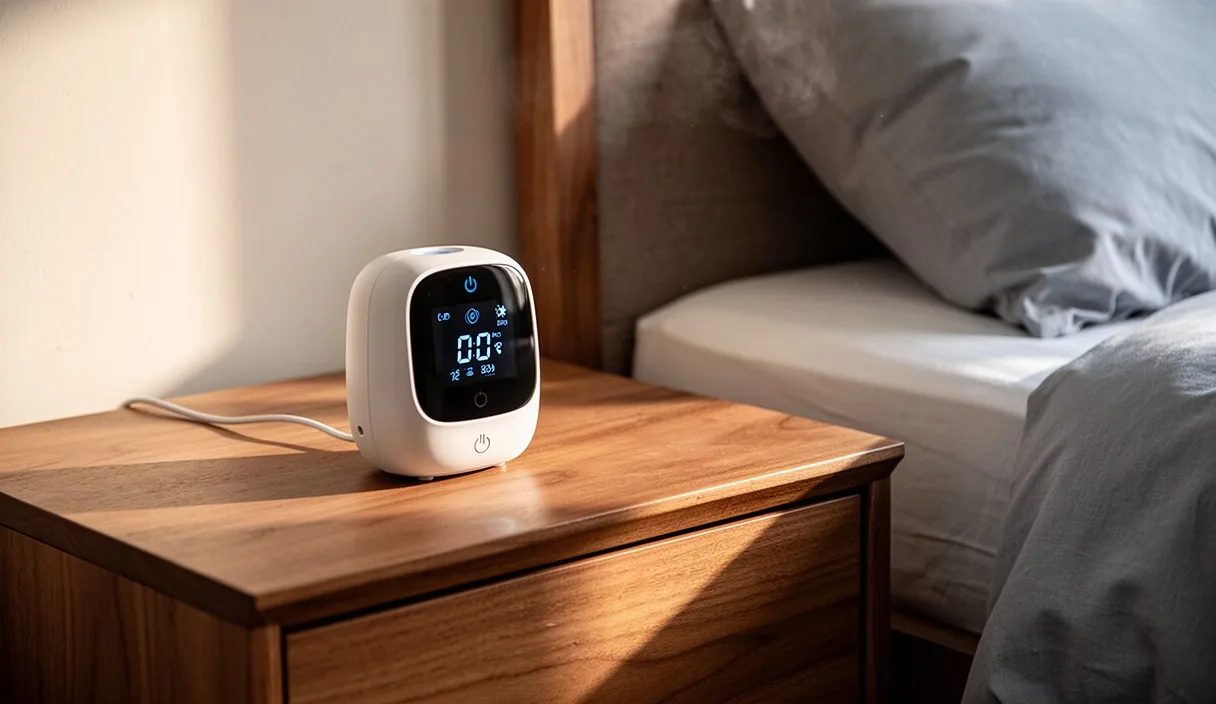
Placing an air quality monitor directly on your nightstand within arm's reach of your pillow will yield misleading measurements. Your breath directly plumes over the sensor, driving carbon dioxide numbers past 2,500 ppm even if the room as a whole is well-ventilated. Mount or place the monitor at head height roughly five to eight feet away from the bed to collect a representative sample of the ambient room air.
Finally, completely weatherstripping a bedroom door and window to stop outdoor noise or drafts turns the room into an unventilated box. Hermetically sealing the bedroom traps carbon dioxide and indoor humidity, leading to condensation on exterior windows and hidden mold growth inside wall cavities.
Practical Next Steps
Start by establishing a quantitative baseline. Place a dual-beam or manually calibrated NDIR carbon dioxide monitor on a dresser across from the bed. Track your readings over three consecutive nights under your current habits, noting the carbon dioxide and PM2.5 levels immediately before getting into bed and right after waking up.
Once you know your baseline numbers, change one variable at a time. Begin by cracking the bedroom door three inches for three nights to evaluate the drop in carbon dioxide. If levels remain above 1,000 ppm, introduce a cracked window or window trickle vent. Next, add a properly sized mechanical HEPA purifier placed away from walls and corners, running on at least medium speed.
If you encounter persistent humidity above 60 percent, persistent musty smells, or continuous respiratory discomfort despite following these steps, stop guessing. Consult an HVAC professional certified by the National Comfort Institute to test your ductwork balance, or hire an industrial hygienist to conduct targeted mold and VOC testing.