Most residential lighting is installed for visibility, aesthetics, and energy efficiency, with almost no consideration for human biology. Standard white LED fixtures emit a heavy spike in blue wavelengths between 450 and 490 nanometers. This wavelength range mimics the noon sun, signaling to the master clock in the brain that it is midday regardless of what the clock on the wall says. When these lights remain on past sunset, the brain delays its natural chemical preparation for rest.
Circadian lighting addresses this conflict by matching the intensity and color temperature of interior fixtures to the natural daylight cycle. Instead of flooding living spaces with uniform white illumination throughout the evening, a circadian configuration provides bright, blue-enriched light after waking, followed by warm, low-lux illumination after dusk. Setting up this type of system does not require completely rewiring a house, but it does require understanding how specific bulb types, Kelvin ratings, and physical fixture positions interact with human ocular anatomy.
How Evening Spectrum Affects Natural Melatonin Rhythms
The human retina contains intrinsically photosensitive retinal ganglion cells, known as ipRGCs. These photoreceptors do not contribute to conscious image vision; instead, they contain the photopigment melanopsin, which reacts specifically to wavelengths between 460 and 490 nanometers. When melanopsin absorbs photons in this range, the cells fire electrical impulses along the retinohypothalamic tract directly to the suprachiasmatic nucleus. This central pacemaker governs peripheral cellular clocks throughout the body and controls the release of nocturnal hormones.
When the suprachiasmatic nucleus receives daytime signals from high-energy blue photons, it suppresses the pineal gland from synthesizing and releasing melatonin. Under natural conditions, sunlight wanes toward dusk, shifting from high blue content to longer, red-dominant wavelengths. As the blue light disappears, melatonin levels begin their dim-light melatonin onset, usually starting two hours before habitual sleep time. This hormonal shift lowers core body temperature, reduces blood pressure, and promotes the onset of restorative sleep.
Artificial lighting with heavy blue emissions stalls this sequence. Standard 4000K or 5000K residential LEDs keep ipRGCs active, delaying the dim-light melatonin onset by an hour or more depending on exposure duration. This delay shortens total sleep duration and reduces the proportion of slow-wave sleep achieved in the first half of the night. Chronic disruption of this cycle is linked to daytime fatigue, metabolic dysregulation, and altered mood states.
Comparing Light Bulb Options Across Kelvin Color Scales
The Kelvin (K) scale measures the correlated color temperature of light, describing its visual warmth or coolness. Low Kelvin numbers indicate warm, amber tones rich in long wavelengths, while higher Kelvin numbers indicate cool, blue-white light. Color temperature alone does not tell the full story, because two bulbs rated at 2700K can have different spectral power distributions depending on their phosphor coatings. However, selecting bulbs with appropriate Kelvin ratings remains the most accessible starting point for residential setups.
Incandescent and halogen bulbs naturally follow a thermal curve: as they dim, their color temperature drops down to roughly 1800K, emitting negligible blue light. Standard white LEDs do not behave this way; they dim in brightness while their spectral profile stays fixed at a high-energy peak, unless they are specifically engineered as "dim-to-warm" fixtures. Smart bulbs that utilize separate red, green, blue, and amber diodes give users precise control over the output, allowing for extreme spectral changes that mimic natural twilight.
| Bulb Type / Rating | Kelvin Range | Blue Spectrum Output | Primary Application |
|---|---|---|---|
| Standard Cool LED | 4000K - 6500K | High (peak at 450-460 nm) | Morning workspaces, utility rooms, garage task lighting |
| Soft White LED | 2700K - 3000K | Moderate | Daytime living spaces, early evening kitchens |
| Dim-to-Warm LED | 1800K - 3000K | Low when dimmed below 30 percent | Evening dining areas, living room accent fixtures |
| Amber / Red LED | 1600K - 2000K | Near zero below 500 nm | Bedside reading, late-night navigation lights |
| Traditional Incandescent | 2400K - 2700K | Low to moderate | Living room table lamps used in late evening |
When shopping for bulbs, verify the Color Rendering Index (CRI) alongside the Kelvin rating. Fixtures with a CRI above 90 present colors accurately, which prevents spaces from feeling dingy or unnatural when light levels drop in the evening. For night use, specialty amber or deep red bulbs (under 2000K) eliminate the melanopsin-stimulating band entirely, providing adequate visibility for navigation without resetting the brain's internal clock.
Establishing Dimming Schedules for Evening Living Areas
Color temperature is only one variable; total photon volume, measured in lux at eye level, determines whether melanopsin responds. A 2700K warm bulb can still delay melatonin release if it delivers 300 lux straight into the pupil. An effective evening routine requires systematic decreases in both brightness and color temperature over several hours.
Create a three-stage evening schedule anchored to your target bedtime:
- Three hours before sleep: Reduce general ambient living room lighting to approximately 100 lux. Switch off auxiliary fixtures, such as display backlights, ceiling downlights in perimeter zones, and open kitchen tracks. If you use color-tuning fixtures, dial the temperature down to 2400K.
- Ninety minutes before sleep: Drop the illumination level down to 30 to 45 lux at eye level. Shift the Kelvin rating to 2000K or warm amber. Keep lights localized to specific zones rather than illuminating the entire room volume.
- Thirty minutes before sleep: Turn off all central illumination. Rely solely on directional fixtures rated at 1800K or lower, delivering no more than 10 to 15 lux at the eye. This provides sufficient light to navigate hallways or finish a book without triggering retinal alert pathways.
To implement this schedule reliably, use automated smart switches, programmable bulbs, or mechanical inline plug timers. Expecting yourself to manually adjust rotary dimmers and flip off switches every night invites inconsistency. In setups where smart bulbs are impractical, install low-wattage secondary table lamps fitted with 2-watt amber bulbs, and switch over to them completely after dinner.
Task Lamp Positioning for Morning Alertness
Circadian health is a bidirectional system. You cannot establish strong, predictable evening melatonin production without adequate daylight or bright artificial light exposure early in the day. The retinal ganglion cells require high melanopic lux within the first two hours of waking to anchor the start of the circadian cycle, suppress residual melatonin, and trigger morning daily balance production.
Natural morning sunlight through an open window is the best source, providing 10,000 to 50,000 lux. On overcast days, during winter months, or in windowless home offices, artificial task fixtures must fill the gap. Standard ceiling lights rarely supply sufficient eye-level intensity, typically delivering only 100 to 200 lux to a seated desk worker.
Positioning a dedicated high-lux task lamp correctly requires attention to angle, distance, and intensity:
- Angle of incidence: Place the light source above your eye line, angled downward at roughly 45 degrees. The ipRGCs are concentrated most densely in the inferior and nasal sections of the human retina, making them most sensitive to light coming from above and slightly to the side, exactly how the sky is positioned outdoors.
- Working distance: Keep the luminaire between 40 and 60 centimeters (16 to 24 inches) from your face. Light follows the inverse square law: doubling the distance cuts the received illuminance to one quarter of its original value. Moving a lamp from 45 centimeters away to 90 centimeters away turns an alerting 1000-lux stimulus into a dim 250-lux glow.
- Glare mitigation: Use a fixture with a wide diffusion panel rather than an exposed bare point source. Looking directly at concentrated LED points creates retinal discomfort and causes squinting, which defeats the goal of exposing the ipRGCs to photon flux.
Run this task lamp at 5000K to 6500K for 30 to 45 minutes immediately after waking while eating breakfast or reviewing morning schedules. Turn it down or off by noon to allow your biological sensitivity to re-calibrate for the evening decline.
Minimizing Overhead Light Exposure Before Bedtime
The human visual architecture evolved under a clear spatial paradigm: natural light comes from above during the day, while evening light historically came from ground-level fire or low embers. Because ipRGC density is highest in the lower half of the retina, light directed downward from the ceiling strikes these cells with maximum efficiency. Overhead recessed cans, flush mounts, and track lights are the most disruptive fixtures to use after sundown.
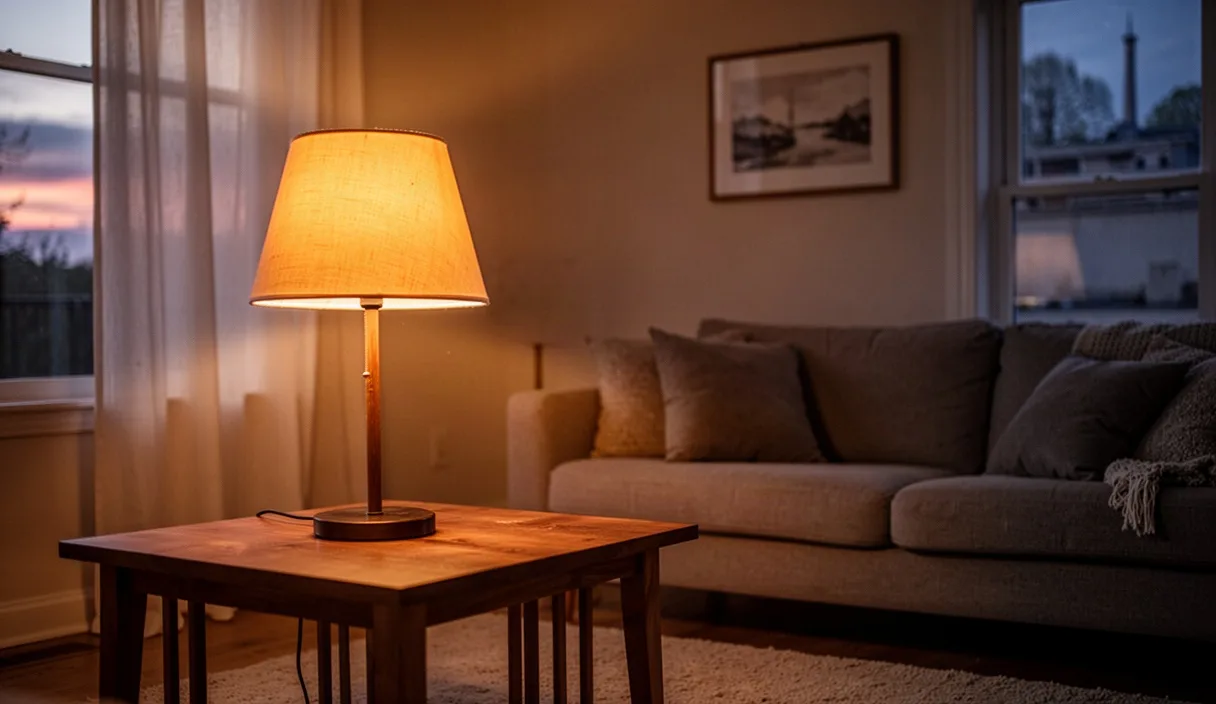
To protect the evening window, shift all lighting from vertical to horizontal orientations. Turn off ceiling fixtures entirely once the sun sets. Instead, rely on table lamps, low wall sconces, floor-level uplights, and baseboard-mounted nightlights. A lamp situated at knee height or hip height directs its photons toward the superior retina, which has a much lower density of ipRGCs, reducing the biological signal of alertness.
Consider shade design when selecting evening lamps. Drum shades and opaque parchment cones that force light to escape strictly through the bottom onto a surface are superior to exposed filament bulbs or translucent glass globes. Translucent globes disperse high-angle glare across the entire horizontal field of view. By directing the pool of light downward onto a wooden side table or dark rug, the light bounces back into the room as scattered, low-intensity, long-wavelength reflections.
In bathrooms and hallways, where late-evening exposure is common, disable the main ceiling switches after 8:00 PM. Install magnetic battery-operated motion pucks or plug-in wall guides with amber emitters emitting less than 5 lumens along the baseboards. This provides safe passage during nighttime bathroom trips without shocking the circadian clock back into daytime mode.
Common Mistakes
- Confusing warm color with low intensity: A 2200K bulb operating at 800 lumens can still inhibit melatonin production. Color temperature and total photon volume must both decrease in tandem.
- Relying on digital screen warm modes alone: Built-in night settings on phones and monitors warm the screen spectrum, but holding the device 25 centimeters from your face delivers high lux regardless of color. Screen proximity must be managed alongside room fixtures.
- Overlooking indirect white bounce: Painting walls bright reflective white can counteract low-wattage bulbs. Light from a single unshaded bulb bounces off reflective surfaces, raising overall ambient room lux higher than intended.
- Ignoring midday light exposure: Spending the entire day in a dim room makes your retinal receptors hypersensitive to artificial light at night. Robust evening sleep rhythms depend on strong light contrast between noon and midnight.
Practical Next Steps
Begin with an audit of your primary evening space. Download a basic lux meter app on your phone. While phone sensors are not lab-grade instruments, they give a functional estimate of illumination changes. Sit in your usual evening chair at 8:30 PM and measure the lux reading at eye level. If the measurement exceeds 50 lux, you have identified a clear intervention point.
Address lighting changes incrementally. Unscrew cool white bulbs from bedside lamps and replace them with warm 2200K or amber 1800K LED options rated under 400 lumens. Relocate tall task lights or floor uplights so their illumination stays below eye height. If your main living space relies solely on high-hat ceiling fixtures, purchase two affordable plug-in table lamps with opaque shades and use them exclusively after dinnertime.
For individuals dealing with persistent circadian rhythm disorders, delayed sleep phase syndrome, or chronic restful sleep support, these home environmental adjustments should be paired with medical guidance. Consult a board-certified sleep specialist or your primary care physician to rule out underlying clinical conditions before relying exclusively on environmental lighting changes.